

Montessori
About Montessori Education
Montessori refers to an educational approach developed by Dr. Maria Montessori, an Italian physician and educator, in the early 20th century. The Montessori method is characterized by a child-centered philosophy that emphasizes the development of a child’s own initiative and natural abilities in a supportive and prepared environment.
Key principles of the Montessori method include:
- Child-Centered Learning
- Prepared Environment
- Self-Directed Activity
- Mixed-Age Classes
- Concrete Learning Materials
- Uninterrupted Work Periods
- Teacher as Guide
Montessori students become:
Life-long learners
Prepared for life in today’s society
Proficient in 21st-century skills
Comfortable in different age groups
Empowered & independent
Montessori School
- Multi-age classroom: often working with other children that are 2-3 years different in age
- Self-paced instruction: students choose their own activities and work at their own pace
- Curriculum varies based on the child’s unique interests and pace of learning
- Smaller ratios of students per teacher – often taught in small group settings
- Teachers serve as guides that follow the student
- Learning is completed through self-correction and the students’ desire for improvement
- Freedom to move about and speak at any time
- Have the ability to pursue discoveries and individual ideas
- Focuses on the whole child, emphasizing all aspects cognitive development
Traditional School
- Single age classrooms and grade levels
- Teacher-paced instruction: curriculum is often set and the pace of learning determined by the teacher
- One-size-fits all curriculum that remains the same for each student
- Average ratio of 25:1 students per teacher
- Teachers serve as the authority figure which is always dominant to the student
- Learning is motivated based on a punishment and reward system
- Strict rules, boundaries and schedules that structure where students move and when they speak
- Teacher’s guidance limits what topics can be pursued and when
- Focuses on predetermined sequences of cognitive development, along with an emphasis on social development
An authentic Montessori school will implement a philosophical approach that is consistent with the educational methods and areas of instruction as defined by the observations, research, writings and instruction of Dr. Maria Montessori.
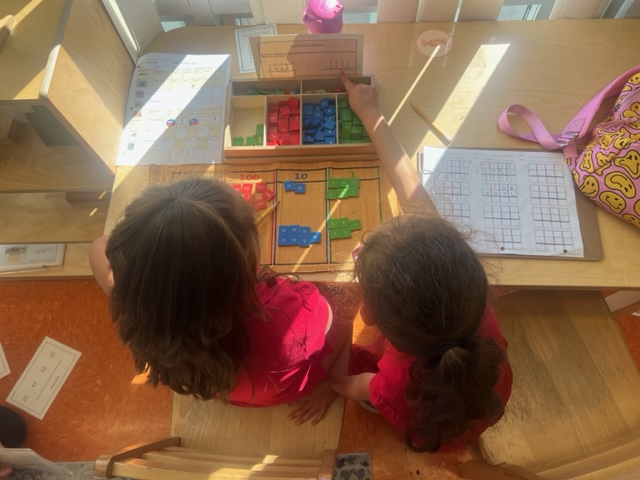
A Montessori school must allow the child to develop naturally. Children are able to learn at their own pace and follow their own individual interests, learning primarily through the hands-on use of scientifically prepared auto-didactic materials, and interacting with the environment under the guidance of a specially trained adult. A Montessori environment promotes the child’s ability to find things out independently, enabling motivation and knowledge-building through internal development rather than external teaching or rewards.
An authentic Montessori school will apply the following pedagogical elements.
It is critical that all of these elements be present in order for the Montessori approach to be successfully implemented. Montessori schools should:
Implement the Montessori curriculum, which must include:
- A classroom design that is compatible with Montessori “prepared environment” principles.
- A full complement of Montessori materials for each class and age group.
- Uninterrupted Montessori daily work periods, with 3-hour work periods being the ideal.
- Instruction characterized by a high degree of freedom given to the student to choose what to work on, where to work, and how long to work.
- Instruction that primarily takes place in small groups (Elementary and Secondary) or one-on-one (Early Childhood).
Have appropriately trained instructional staff defined as:
- Having a lead teacher in each classroom with an AMI, AMS, NCME , and/or MACTE accredited teacher education program credential at the level being taught.
- Having staff members engage in ongoing Montessori professional development.
Have classrooms:
- With the appropriate multi-aged groupings: 2.5/3-6, 6-9, 9-12, or 6-12 years of age. Children from birth to 3 years of age and 12-18 years of age may be grouped in varying multi-age configurations.
- With class sizes and adult/child ratios that align with Montessori principles. Montessori classroom standards require larger class sizes and higher student to teacher ratios than is typically seen in traditional classrooms. Adding additional teaching staff to a Primary classroom can interfere with, rather than encourage, child-directed learning. It would not be uncommon to see 30 or more children in a classroom at the early childhood and elementary levels.
Assess student progress through:
- Teacher observation
- Detailed record keeping
Montessori Students...
A student in Montessori receives a holistic education that begins with offering opportunities for self care, self regulation and self management and the development of an internal locus of control whereby the child can gradually assume responsibility for self and his/her education. A successful and joyful student in a Montessori program embodies the principles of the Montessori philosophy, which emphasizes independence, exploration, and a love for learning.
Click here to learn more about a successful and thriving Montessori student!
Montessori Families...
A successful and joyful Montessori family embraces the principles of the Montessori philosophy both within the classroom and in their home environment. These principles include respectful communication, independence, a structured environment, collaborative decision making, and a joyful learning atmosphere.
Click here to learn more about a successful and thriving Montessori family!
Montessori at San Antonio ISD
San Antonio ISD has two campuses offering a Montessori education: Rodriguez Montessori Elementary (Pre-K–5th grade) and Steele Montessori Academy (Pre-K–8th grade). Pre-K is full day and tuition free at both campuses.
Both of San Antonio ISD’s Montessori campuses are in-district charter schools and are open to students from all over Bexar County and beyond. Both schools feature a variety of fine arts and extracurricular opportunities. Additionally, Rodriguez Montessori Elementary offers an optional Dual Language pathway for interested families. (Students wishing to participate in the Dual Language pathway at 2nd grade or above should be able to demonstrate Spanish proficiency.)

Rodriguez Montessori Elementary
- Serves grades Pre-K through 6th grade
- Full-day, tuition-free Pre-K
- Implements Montessori philosophy and curriculum
- Offers an optional Dual Language pathway
- Features mixed-age classrooms
- Has Gifted & Talented and Social-Emotional Learning curriculum
- Uniform is required
- Fine Arts include Visual Arts and Elementary Music
- Clubs include Book Club, Chef/Cooking opportunities, Gardening Club
- After-School Care: YMCA of Greater San Antonio
- Admission method: Choice Application
Steele Montessori Academy
- Serves grades Pre-K through 8th grade
- Full-day, tuition-free Pre-K
- Implements Montessori philosophy and curriculum
- Features mixed-age classrooms
- Has Gifted & Talented and Social-Emotional Learning curriculum
- Uniform is required
- Fine Arts include UIL Creative Writing & Storytelling
- Clubs include Chess Club, Meditation Club, Nepohualtzintzín Club, Robotics Club, Gardening Club, Folklórico Club
- After-School Care: YMCA of Greater San Antonio
- Admission method: Choice Application
In 2021, Public Montessori in Action International has entered into a Partnership Agreement with San Antonio ISD to lead the unique and innovative work at Rodriguez Montessori Elementary and Steele Montessori Academy. Click below to learn more!
Keep reading to learn how to apply for admission. Then, click on a Montessori school below to see details on the academic programming, fine arts, extracurricular activities, and other benefits that each one offers.
Enrolling in a Montessori school with San Antonio ISD
Both of San Antonio ISD’s Montessori schools are open to students from all across Bexar County and surrounding areas. An application is required to gain admission. Students living inside and outside SAISD’s boundaries are welcome to apply! Explore your Montessori options below and apply for up to 8 total Choice Schools & Magnet Programs today!
Transportation is provided at no cost for all students from numerous pick-up and drop-off locations throughout the district.